
Disclosure: This article contains affiliate links. As an Amazon Associate, we earn from qualifying purchases, at no extra cost to you. Our picks are based on published specifications, FDA clearance, and fit for back pain, not on commission. This article is for general information and is not medical advice. Read our full affiliate disclosure.
A portable TENS unit can lower back pain while it runs and for a short time afterward, but it does not treat the cause of the pain. That is the honest summary of more than 30 years of trials. This guide shows what the research says, where to put the pads, which settings to start with, who should skip TENS entirely, and how to pick a device that is worth your money.
Quick Picks: Best Portable TENS Units for Back Pain
If you already know TENS is worth a try, these four FDA-cleared, over-the-counter units cover the main buying needs. We selected them from manufacturer specifications, FDA clearance, and how well they support the pad layout and settings in this guide; they were not hands-on tested.
| Pick | Best for | Key specs | Buy |
| TENS 7000 2nd Edition | Best overall: full manual control | Dual channel; 2–150 Hz; 50–300 µs; up to 100 mA; 9V battery | Check Price on Amazon |
| AUVON Dual Channel TENS EMS | Best rechargeable value | Dual independent channels; 24 modes; 20 intensity levels; up to 10 h battery; 12 pads | Check Price on Amazon |
| iReliev Wireless TENS + EMS | Best wireless | 2 wireless pods (expandable to 4); 8 TENS + 6 EMS modes; up to 80 mA; rechargeable | Check Price on Amazon |
| Omron Pocket Pain Pro (PM400) | Simplest to use | Single channel; dedicated lower-back mode; 10 intensity levels; 2× AAA | Check Price on Amazon |
Full pros and cons for each pick follow the buying checklist below.
What a Portable TENS Unit Is (and What It Isn’t)
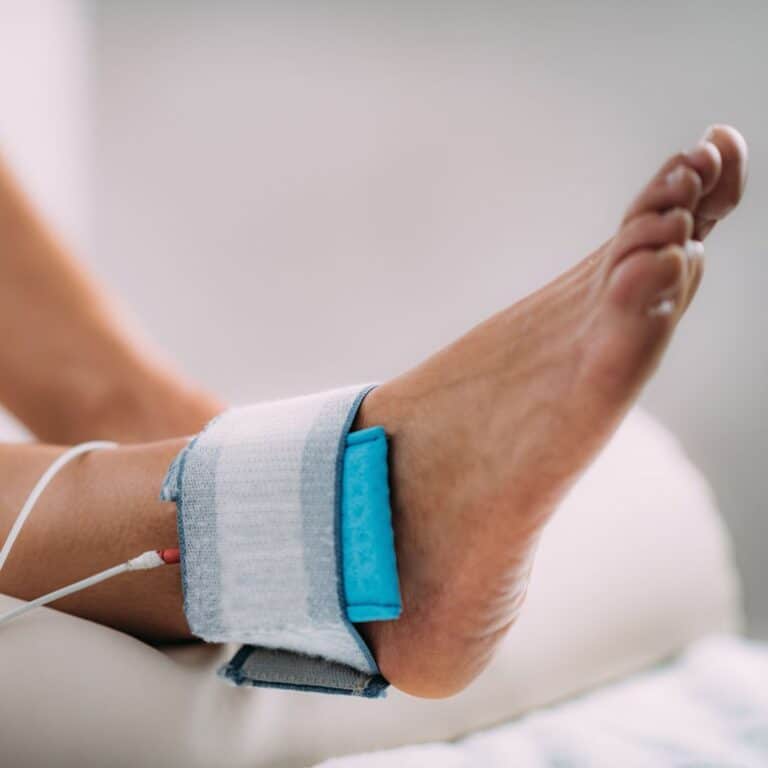
TENS (transcutaneous electrical nerve stimulation) is a method of easing pain by sending mild electrical pulses through electrodes stuck to the skin. A portable TENS unit is a battery-powered version small enough to clip to a belt or stick directly on your back.
The pulses target sensory nerves, not muscles. That is the key difference from EMS (electrical muscle stimulation), which makes muscles contract. Many consumer devices combine both modes, so check which program you are actually running.
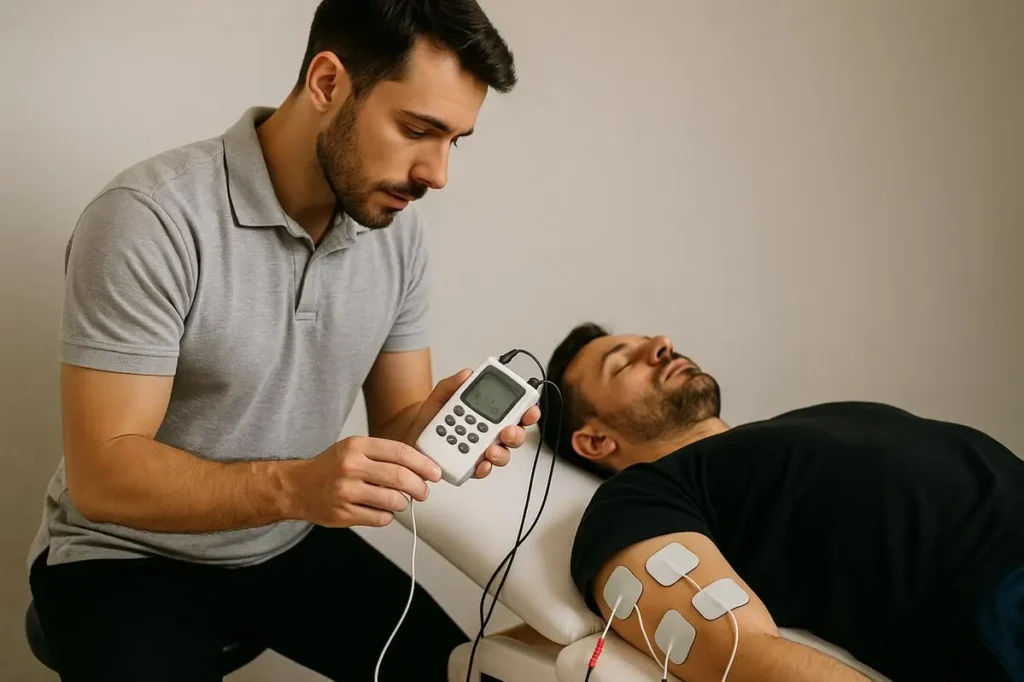
Portable units also differ from clinic machines. A physical therapist’s device usually offers finer control over each parameter. A home unit trades some of that control for convenience: you can use it at your desk, on a walk, or in the car as a passenger.
How TENS Eases Back Pain?
TENS works mainly through two mechanisms. The first is the gate control theory: the tingling signal travels on fast nerve fibers and competes with pain signals in the spinal cord, so less pain reaches the brain. Researchers sometimes describe it as electrically rubbing pain away.
The second mechanism applies to low-frequency settings. Slower, stronger pulses are linked to the release of the body’s own opioids (endorphins). This is why many devices offer both high- and low-frequency programs.
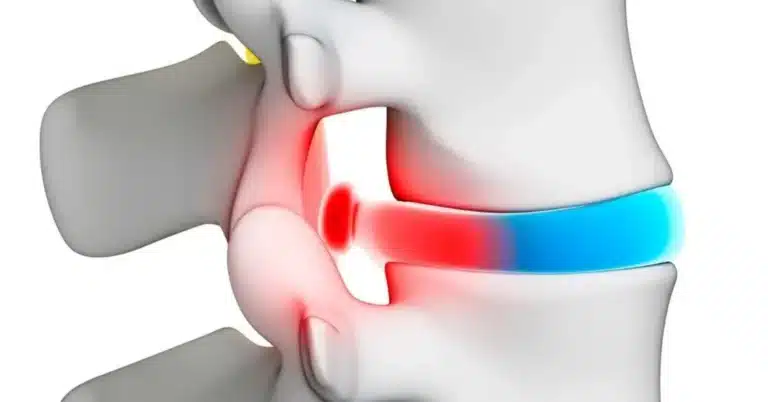
Here is the practical implication: relief is strongest during stimulation and fades after you switch the unit off. TENS manages symptoms. It does not heal a disc, strengthen your core, or correct posture.
Does a TENS Unit Actually Work for Back Pain?
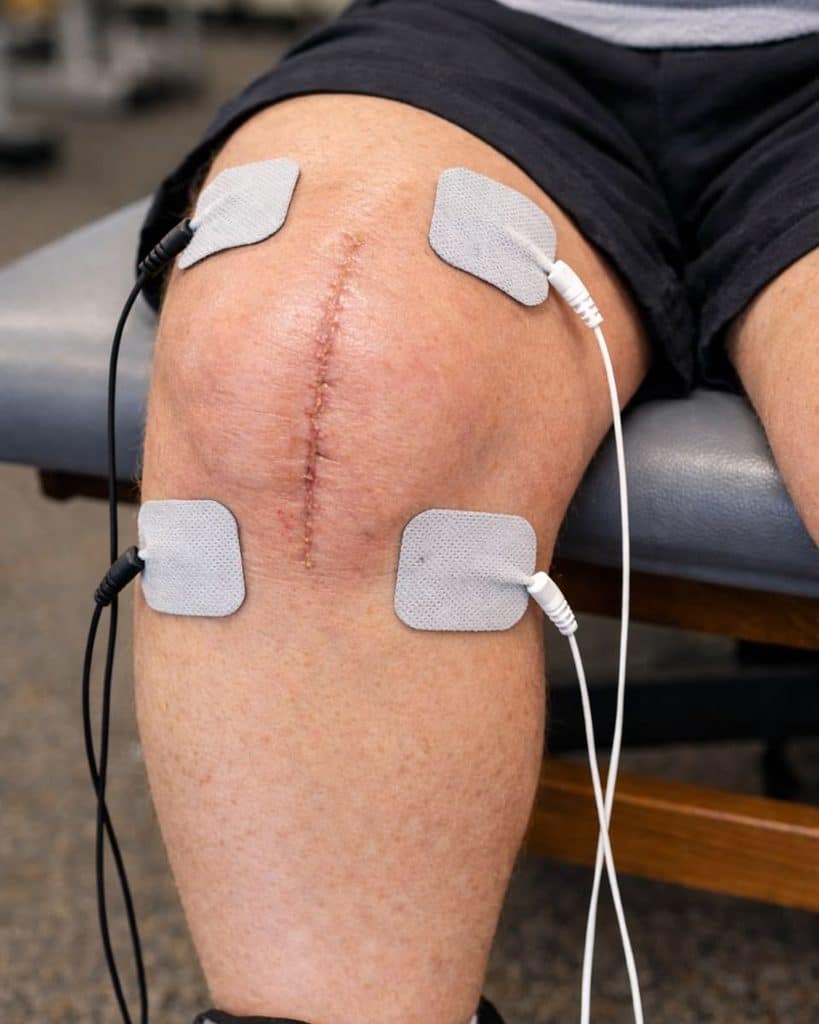
Does TENS work for back pain? It reduces pain intensity during and right after use for many people, but major guidelines do not recommend it as a routine treatment for chronic low back pain. Both statements are true, and the table shows why.
| Source | What it studied | Finding |
| meta-TENS study, BMJ Open (2022) | 381 trials, 24,532 adults, all pain types | Pain was lower during or immediately after TENS than placebo; moderate-certainty evidence; no serious adverse events |
| WHO-commissioned review (2023) | TENS for chronic primary low back pain | Brief, marginal pain reduction the authors judged not clinically important; very low certainty |
| WHO guideline (Dec 2023) | Non-surgical care of chronic primary low back pain | TENS listed among interventions not recommended for routine care |
| NICE NG59 (UK, updated 2020) | Low back pain and sciatica in adults | “Do not offer TENS” for low back pain with or without sciatica |
| Cochrane review (2008) | 4 trials, 585 patients with chronic low back pain | Conflicting evidence on pain; two trials (410 patients) showed no improvement in disability |
How do you reconcile these? The broad meta-analysis measured pain during and right after stimulation, across many conditions. The back-pain guidelines asked a harder question: does TENS improve function and long-term outcomes for chronic low back pain? On that question, the evidence is weak.
The takeaway: TENS is a short-term pain-control tool, not a treatment that changes the course of back pain. If you use it to make movement and exercise more tolerable, it fits what the evidence supports.
Who Tends to Benefit Most
TENS is most useful for people who want drug-free relief during specific activities, such as a long workday, a commute, or a stretching routine. It also suits people who cannot take NSAIDs or want to cut down on them; discuss that change with your doctor first.
It is less useful if you expect it to replace exercise or physical therapy. Guidelines from both NICE and WHO put structured exercise and education first for chronic low back pain.
Where to Place TENS Pads for Lower Back Pain?
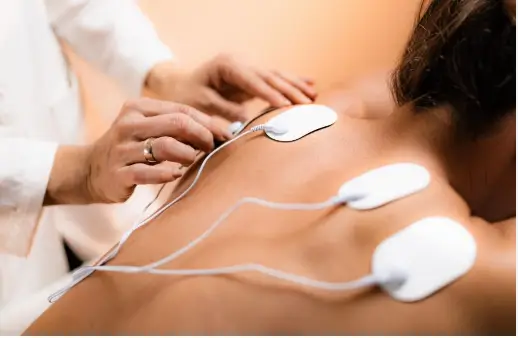
Where should TENS pads go for lower back pain? Place them on the muscles on either side of the spine, around the painful area, never directly on the spine itself.
A common two-channel layout for lower back pain:
- Find the center of your pain.
- Place two pads from channel A vertically on the left side, about 5 cm (2 in) from the spine, one above and one below the pain.
- Place two pads from channel B in the same way on the right side.
- Keep at least 2.5 cm (1 in) between any two pads so the current does not jump across a short gap.
Avoid these placements:
- Directly over the spinal column
- Over the front or sides of the neck, the head, or the eyes
- Anywhere the current could cross the chest (for example, one pad on the chest and one on the back)
- On broken, irritated, or numb skin
[Source required: confirm the 5 cm / 2.5 cm spacing against the chosen device manufacturer’s manual, which overrides general guidance.]
Best TENS Settings for Back Pain
Start with conventional (high-frequency) TENS, then adjust based on how you respond. Most portable units have presets that map to these ranges.
| Setting | Conventional TENS | Acupuncture-like TENS |
| Frequency | 80–150 Hz | 1–10 Hz |
| Pulse width | 50–200 µs | 200–250 µs |
| Intensity | Strong but comfortable tingling | Strong; visible muscle twitch |
| Sensation | Continuous buzzing | Rhythmic tapping |
| When to try it | First choice for most people | If high frequency stops helping or is uncomfortable |
How strong should TENS feel? Strong but comfortable, never painful. The meta-TENS review specifically pooled trials using strong, non-painful stimulation, and weak tingling is a common reason people conclude TENS “doesn’t work.”
Sessions in clinical trials typically ran 30–60 minutes. Many people use TENS several times a day during activity, but follow your device’s maximum session time.
Here’s where most people get this wrong: they use the same program every day. Repeated stimulation at the same frequency and intensity can build analgesic tolerance, so the relief shrinks over a week or two. Alternate between high- and low-frequency programs, or use a modulation (mixed-frequency) mode, to keep it effective.
Who Should Not Use a TENS Unit?
TENS is low-risk for most adults; the most common side effect is mild skin irritation under the pads. Still, some people should not use it without medical approval:
- People with a pacemaker, implanted defibrillator, or any other implanted electronic device
- People with epilepsy or a heart rhythm disorder
- Pregnant people, especially near the abdomen, pelvis, or lower back, unless their obstetric team approves
- Anyone with cancer, active bleeding, or a blood clot in the area
- Anyone using it while driving or operating machinery
Do not use TENS to mask undiagnosed pain. See a doctor before starting if your back pain comes with leg weakness, numbness in the groin or buttocks, loss of bladder or bowel control, fever, unexplained weight loss, or a recent fall or injury.
How to Choose a Portable TENS Unit: 7-Point Checklist
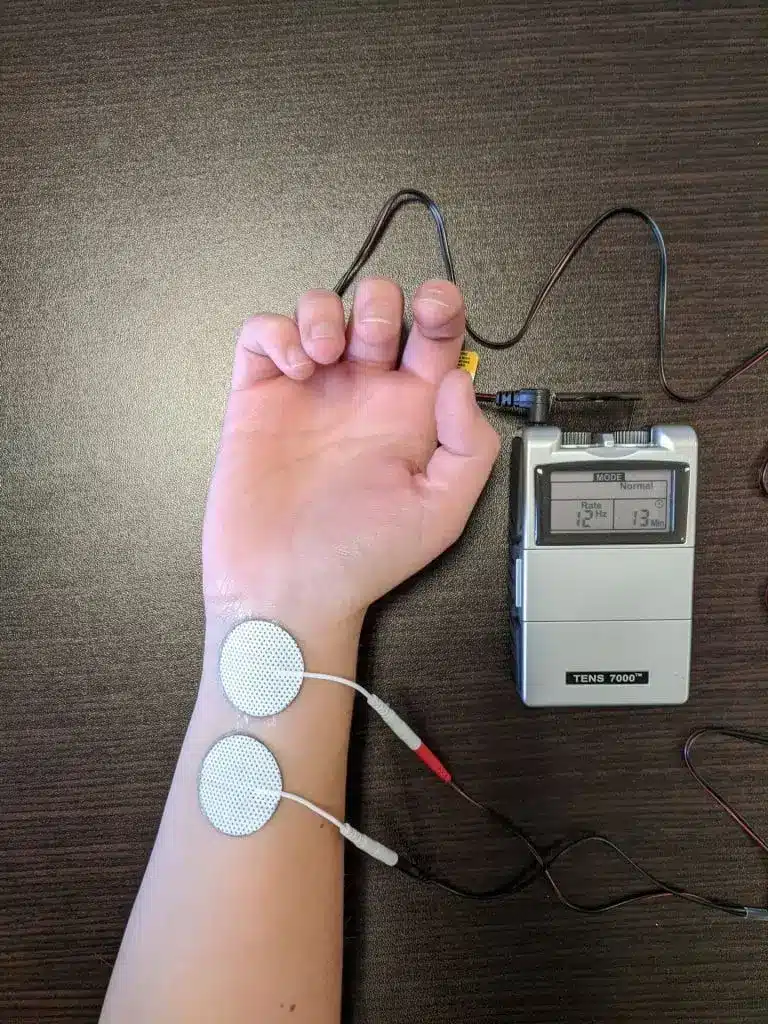
The right device is the one you will actually use consistently and safely. Use this checklist before you buy:
- FDA clearance (US) or CE marking (EU/UK). In the US, over-the-counter TENS units are Class II devices cleared through the 510(k) process under product code NUH. “FDA cleared” means the device is substantially equivalent to one already on the market; it is not proof that it relieves your back pain.
- Indication on the label. Over-the-counter units are usually cleared for temporary relief of sore and aching muscles. Prescription units can carry broader indications, such as chronic pain.
- Two independent channels. Back pain usually needs four pads, so two channels with separate intensity controls give you more control.
- Adjustable frequency and pulse width. Fixed presets alone make it harder to prevent tolerance.
- Wired or wireless. See the comparison below.
- Pad cost and availability. Pads wear out with use. Check the price and availability of replacements before you commit to a device.
- Return policy and warranty. Response to TENS varies a lot between individuals. A return window lets you test it on your own back.
| Factor | Wired unit | Wireless unit |
| Mobility | Cables can catch on clothing | Pads stick on; easy under clothes |
| Control | Physical buttons, usually more settings | Remote or app; varies by model |
| Pad positioning | Flexible; four pads anywhere | Pod shape can limit placement |
| Best for | Home use, fine-tuned settings | Use at work or while moving |
Best Portable TENS Units for Back Pain: Pros and Cons
Each pick below is scored against the checklist above, not against star ratings.
TENS 7000 2nd Edition — Best Overall
Best for: People who want to follow the settings table in this guide exactly.
The TENS 7000 lets you set the pulse rate (2–150 Hz) and pulse width (50–300 µs) by hand, which is rare at this price. That control makes it easy to switch between conventional and acupuncture-like TENS and prevent tolerance. Its two isolated channels run the four-pad back layout, and it is FDA-cleared for over-the-counter sale.
- Pros: Full manual control; Burst, Normal, Modulation and Strength-Duration modes; 5–60 minute timer or continuous; built-in usage log
- Cons: Wired; runs on a 9V battery, not rechargeable; dated interface
Check the TENS 7000 2nd Edition on Amazon →
AUVON Dual Channel TENS EMS — Best Rechargeable Value
Best for: Daily users who want a rechargeable unit without a premium price.
The AUVON combines TENS, EMS and massage programs in one rechargeable unit that runs up to 10 hours per charge. Channels A and B have independent intensity, so each side of your back can run at its own level. It uses standard 2 mm pin connectors, so compatible replacement pads are easy to find.
- Pros: Rechargeable; independent dual channels; 12 pads included; standard connectors
- Cons: Relies on preset programs rather than fully manual frequency control; many modes are massage-style rather than classic TENS; several similar AUVON models exist, so check the model number
Check the AUVON Dual Channel TENS EMS on Amazon →
iReliev Wireless TENS + EMS — Best Wireless
Best for: Wearing TENS under clothes at work or while moving.
The iReliev system replaces cables with pods that snap onto the pads and are controlled from a handheld remote. The base kit has two pods, and you can add a third and fourth for the full four-pad back layout. It offers 8 TENS and 6 EMS programs with output up to 80 mA.
- Pros: No cables; expandable to four pods; TENS and EMS in one system; rechargeable
- Cons: Proprietary pads cost more than standard ones; pods and remote need regular charging; pod size limits very small or precise placements
Check the iReliev Wireless TENS + EMS on Amazon →
Omron Pocket Pain Pro (PM400) — Simplest to Use
Best for: First-time users who want one button for lower back pain.
The Pocket Pain Pro has a dedicated lower-back program, 10 intensity levels, and a pocket-size body from a major medical-device brand. It is the easiest unit here to start with.
- Pros: Very simple; preset lower-back mode; compact; long-life pads available
- Cons: Single channel, so only two pads, which falls short of the four-pad layout above; no manual frequency or pulse-width control; short session timer; runs on AAA batteries
Check the Omron Pocket Pain Pro on Amazon →
FAQ
Can I use a TENS unit every day for back pain?
Yes, most adults can use TENS daily if the skin under the pads stays healthy. Rotate pad positions slightly and alternate programs to limit skin irritation and tolerance. Follow your device’s maximum session length.
Can I sleep with a TENS unit on?
No. Manufacturers generally advise against it because you cannot react if the pads loosen, the skin gets irritated, or the intensity becomes uncomfortable. Use it before bed instead.
Is TENS good for sciatica?
The evidence is weak. The UK’s NICE guideline advises against offering TENS for low back pain with or without sciatica. Some people still get short-term relief, but sciatica with leg weakness or numbness needs a medical assessment first.
What is the difference between TENS and EMS for back pain?
TENS stimulates sensory nerves to reduce pain signals. EMS stimulates motor nerves to make muscles contract, which is used more for muscle activation and recovery. For pain relief, TENS mode is the relevant one.
Do I need a prescription for a TENS unit?
Not for over-the-counter units in the US, which are FDA-cleared for temporary relief of sore and aching muscles. Prescription units carry broader indications, and some insurers cover them only with a prescription. [Source required: confirm insurance/HSA rules for the target market.]
Why did my TENS unit stop working after a few weeks?
The most likely reason is analgesic tolerance from using the same settings every session. Switch between high- and low-frequency programs or use a modulation mode. Worn-out pads that no longer stick well also weaken the signal.
The Bottom Line
A portable TENS unit is a reasonable, low-risk way to take the edge off back pain during daily activities. It is not a cure, and guidelines rank exercise and education ahead of it. Use it to make movement easier, rotate your settings, and keep your doctor in the loop.